
Goum
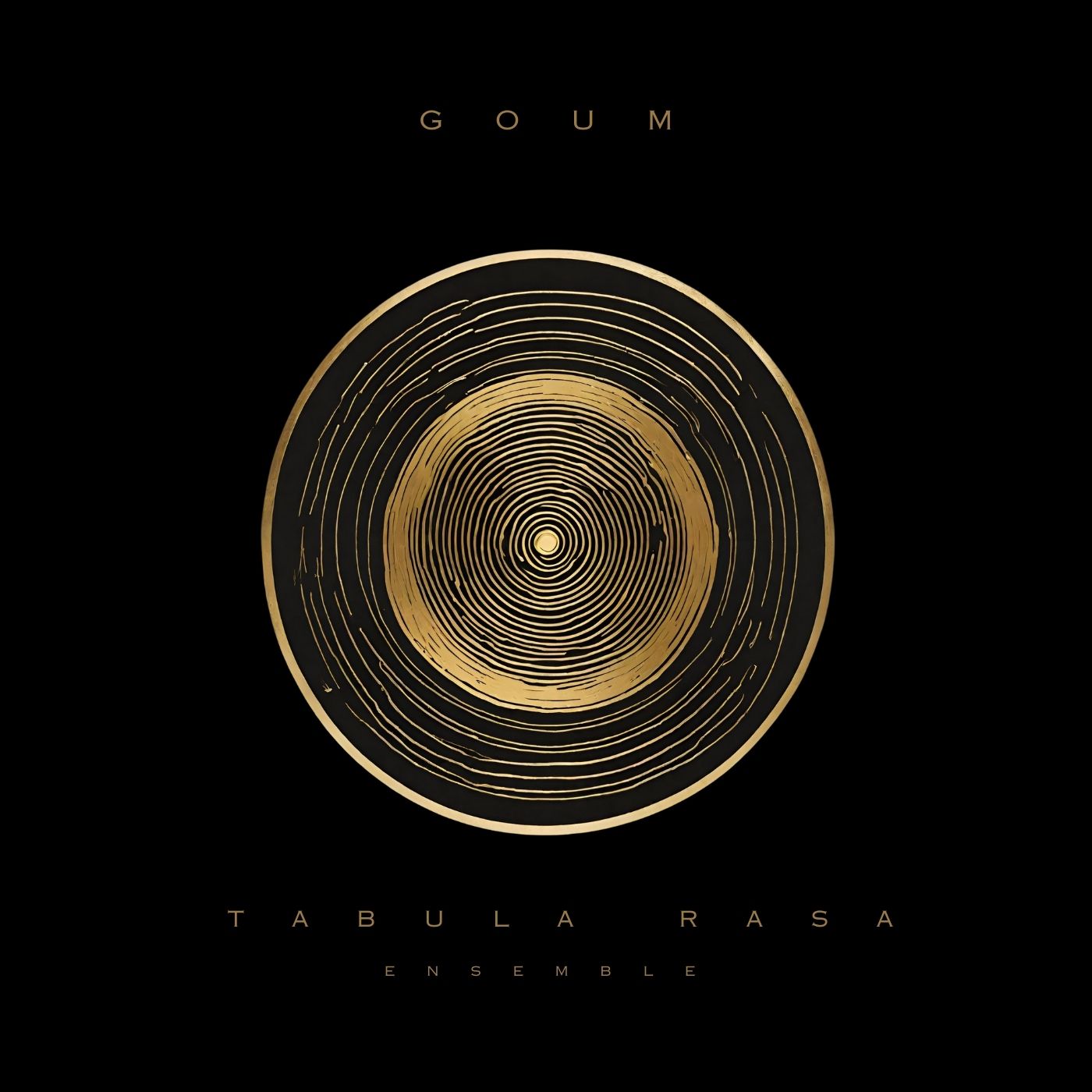
Tabula Rasa Ensemble
Music By Stefano Battaglia
Recording October 2021
Mixing / Mastering July 2022 Studio Artesuono – Cavalicco (Udine)
Sound Engineer Stefano Amerio
Artistic Production Stefano Battaglia, Tabula Rasa
Executive Production Accademia Musicale Chigiana
Co-production Siena Jazz – Accademia Nazionale del Jazz
Cover Astra Limen Artwork
Graphics Elisa Caldana
Available on
KUM! 3 CD BOX SET available on
It is the album of orations, of the spoken word and language, of speeches and prayers, of invocations and confidential murmurs, of discourse and eloquence, of dialogue and conversation.
The term Goum has very ancient Semitic origins. The peoples of Western Asia—Arabs and Jews—expressed themselves in a concrete language, in which words derived directly from lived experience. To refer to God—an abstract word indicating splendor—they used “He who is, who was, and who is to come” instead of “the Eternal.” Or “for ages of ages,” a formula indicating a span of time, instead of “eternity.”
Sharing the same root as kum (qâma), goum is a radiant word in the Arabic language, containing a threefold idea of tribe, life, and resurrection: a people who stand up and return to life.
Since ancient times, the Berbers inhabited the Maghreb, and under Christian and Islamic influences gradually lost traces of their own civilization—except for some tribes who took refuge in the Atlas Mountains. The Turks were the first to recognize their identity, granting them official existence and a defined tribal structure. The Goum were free peoples who managed to escape invasions and elude domination until the early twentieth century, when—from free marauders—they slowly transformed into militarized auxiliary forces, armed and equipped by the French during the Second World War.
The word Goum, full of freedom and of a close, life-affirming fraternity, evokes a nomadic people walking the path of liberty, fleeing the destructive grip of godless societies surrounding them, as one of their principles declares.
GLOSSARY
1. Daleth
It is the fourth letter of many Semitic alphabets (Syriac, Hebrew, Arabic, Phoenician). Its hieroglyph, dating back to the Bronze Age, depicts a door. It opens the album—it is the entrance to this collection of orations.
The musical writing of these orations is morphological, based on the symbolic figure of the triangle: one or two instruments aligned on its axis, and one taking on the narrative function of chanting, invoking, praying. In Daleth, the piano forms the apex, with harp and percussion at the base.
The introductory psalmody and the coda are entrusted to an angelic figure such as Harris Lambrakis and his ney, which indeed sings as an angel would. The ney is the emblematic instrument of prayer; its voice embodies the human condition of divine longing.
The 13th-century Afghan theologian Jalal-al-Din Rumi, through his mystical poetry, teaches that just as the reed is separated from the reed-bed, so too does the human being live in separation from his Creator. And to this day, at his tomb in Konya, one can hear the sound of a ney.
Because of the symbolic emphasis attributed to the ney by the Persian mystic, the instrument soon took on a dominant role in the Sufi circles of Baghdad, in a ritual practice of listening to the Qur’an called sama, during which poetic compositions and music were gradually introduced.
A profoundly melodic instrument, capable of evoking the human voice with all its inflections, the ney was entrusted with the important task of introducing—through an improvisation known as taqsim (or taksim in Turkish)—the mode or maqam upon which all subsequent pieces of the sama would be rooted.
“Since the day they tore me from the reed-bed,
my sweet sound has made men and women weep!
I seek a heart—a heart torn by separation from the Beloved,
that I might explain to it the passion of Love’s desire;
For whoever remains far from his Origin
forever longs to return to the time when he was united with it.
This cry of the ney is fire, not wind;
and whoever lacks this fire deserves to fade into nothingness!
It is the fire of Love that has fallen into the ney,
it is the fervor of Love that has filled the wine [mey].
The ney is the faithful companion of the one torn from the Friend;
its melodies still rend our hearts.”
2. Goum
It is once again the mantric melody of Kum! and Qawm, this time treated as a circle dance. Evening falls, and the nomadic tribe—after the day’s journey—gathers close around the great fire to celebrate life.
The night and the desert, the music and the scent of food, the singing and the dancing, the moon and the stars.
3. Secretum
One of the most intriguing aspects of Mark’s account of the day of miracles is precisely the messianic secret. The narratives describing the miracles of Jesus always end with Jesus Himself forbidding the spreading of the event, for only with the Resurrection will the full revelation be given.
The only occasion in which Jesus commands the dissemination of the miracle occurs in Gerasa, during the exorcism of the possessed man. He lives ostracized and alienated among the tombs, as if already dead, prey to destructive forces.
4. Orazioni
The second oration is for two voices, guitar, and ancient cymbal, built upon the dialogue between two sung prayers: the Kyrie Eleison in Latin and in Greek—an invocation (originally Greek) placed in Christian liturgy between the Introit and the Gloria.
Its glory and its hope lie in the vision of one day hearing an immense chorus of intertwined prayers, each people praying to their God—whoever He may be—in peace and harmony.
That land is sacred to three religions and today, after decades of horrors and the ongoing suffering of the Palestinian people in Gaza, a path toward coexistence must be found at all costs.
Lord, have mercy on us, says the Kyrie Eleison.
Today, this prayer is necessarily dedicated to the Palestinian people.
Goum!
5. Kefar Nahum
This is the third oration, for soprano saxophone (the orator), prepared piano, and percussion: it is a journey.
Capernaum (in Hebrew Kefar Nahum, literally “village of fishermen”) is the place on the Lake of Tiberias toward which Jesus travels to begin preaching after leaving Nazareth, performing numerous miracles and establishing the center of His teaching.
Unheeded, He eventually came to curse Capernaum.
In rabbinic literature, it was considered a community of Christian heretics.
Here, buried beneath the ground, the house of the apostle Peter was found.
6. Calamo Canto
The Mediterranean—Mare Nostrum—is the mythical and concrete space that connects us (and does not separate us!) from the Middle East.
Apulia—or rather the Apulias, as its inhabitants insist—is, together with Sicily, the land most deeply marked by Arab, Turkish, and Saracen influence. Salento in particular was a crossroads of peoples and religions, and its taranta salentina is one of the symbols of our Mediterranean Italy.
Tradition says that this dance, which originated in the province of Taranto, is linked to the complex ritual phenomenon of tarantism, a term referring to the Lycosa tarentula, the venomous spider common in the Taranto countryside, and to the therapy applied to its bite. Folklore attributed to this venom a range of effects depending on local beliefs: melancholy, agitation, convulsions, psychological distress, physical pain, and moral suffering.
Those who were bitten—or believed they had been bitten—by a tarantula (or by scorpions, insects, or various reptiles) tended toward exaggerated dynamism and turned to choreo-musical therapies, which, through the insistent practice of dance, would induce the expulsion of the venom through sweat and humors.
The sun plays and the sea sings!
Calamo Canto is the bagpipe, formed of multiple reed pipes made from marsh cane.
7. Kum!
This is a second version of the piece that appeared on the album of the same name.
8. Isaah
The fourth oration is a purification rite for voices, harp, ney, and percussion.
It tells the story of the miracle of Isaah, the hemorrhaging woman who had been bleeding for twelve months and who, in her desperation, manages to touch the garment of Jesus and is healed.
9. In Bethlehem
This is a second version of the piece that appeared on the album Qawm.
10. Yair
The fifth oration is once again a trio, with the piano in a recitative prayer alongside the harp and percussion.
It is the prayer of Jairus (Yair), the archisinagogos of Capernaum, who went to the shores of the Sea of Galilee to beg Jesus to heal his twelve-year-old daughter, throwing himself at His feet in despair amid the crowd.
When they arrived, the girl was already dead in the synagogue, and at that point everyone seemed to agree that it was pointless to trouble the miracle-worker. But Jesus reassured them, took the young girl by the hand, and in Aramaic pronounced: “Talitâ kum!”
11. Concilium
The final piece embodies, in its very form, the dialogue between two orations—the sixth and the seventh—both urgent and solemn: the first is a trio with a triangular morphology, the alto saxophone at the apex and the bass flute and English horn at the base. This call has the invocatory character of an assembly, a discussion, a pact between rogues whose agreement must be reached through impassioned argument.
The second part introduces another trio, bearing the mysterious character of a conciliabolo—a secluded gathering, far from the crowd. Here, the soprano saxophone becomes the orator, set against the backdrop of piano and percussion.
I take the occasion of these paradigmatic orations—reflecting the shared research on sound pursued by all the musicians of the Tabula Rasa Ensemble—to express my gratitude and admiration for their ability to use the transformation and transfiguration of sound to attain the specific aims of evocation.
It is confirmation that extraordinary results can be achieved beyond the instrument itself only when the musician reaches the awareness that he himself is an instrument of the music.