
Qawm
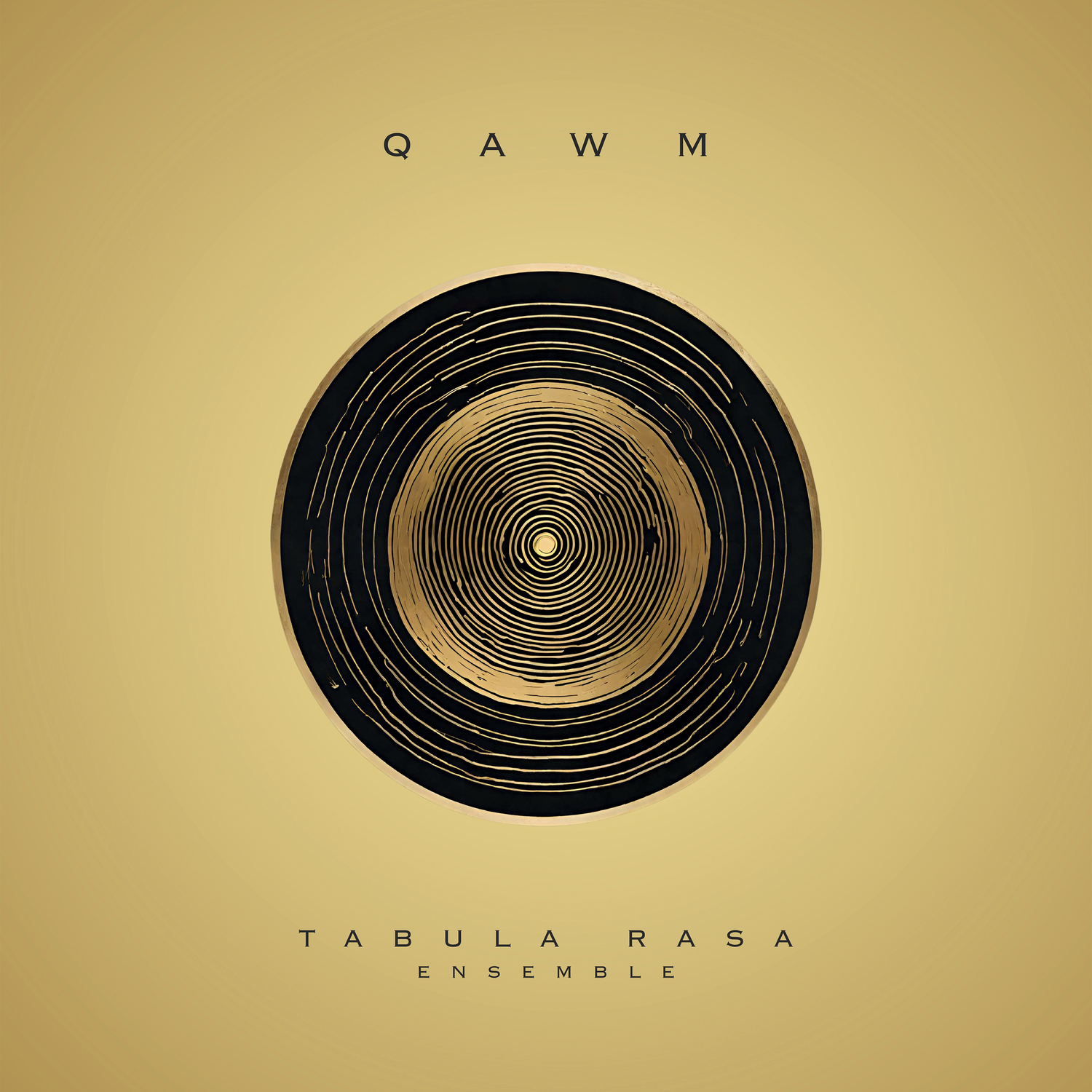
Tabula Rasa Ensemble
Music By Stefano Battaglia
Recording October 2021
Mixing / Mastering July 2022 Studio Artesuono – Cavalicco (Udine)
Sound Engineer Stefano Amerio
Artistic Production Stefano Battaglia, Tabula Rasa
Executive Production Accademia Musicale Chigiana
Co-production Siena Jazz – Accademia Nazionale del Jazz
Cover Astra Limen Artwork
Graphics Elisa Caldana
Available on
KUM! 3 CD BOX SET available on
I consider this the people’s album, a popular work in the truest sense. I am interested in using melody to build a kind of atemporality in the songs—simple chants that could belong to an undefined antiquity.
The Arabic root qâma enriches the concept of resurrection—of rising again—with that of insurrection, of rebellion. It takes on the meaning of an uprising to safeguard a threatened independence, a violated freedom. It means refusing to “die” from the polluted air of conformity.
In the multiplicity of its developments, the root qâma reaches an important stage in the word qâwm or qâmn, which designates a people, a nation, a tribe bound by the same principle—a kinship, a brotherhood in which individualism finds no place.
Musically, this is expressed through popular songs and dances in the strict sense—of the people because from the people.
The compositional formula is mostly the traditional one of repetition with variation, mantric in purpose, both in a sacred and in a magical sense.
Legenda
1. Adunanza
It is the call—the gathering of this tribe.
A primitive tribe, before distinctions, a universal council.
2. Qawm
It is a mantric melody from which individual voices emerge one at a time: a single member steps out from the circle and moves to the center, momentarily rising out of the collective while remaining in dialogue with it.
In music, the mantra preserves its essential nature: a sacred repeated verse and a magical formula.
3. Seyran
It is the paradigmatic story of a people-nation rising in rebellion.
The idiomatic influence comes from my passion for Kurdish music. The Kurds are an Iranian ethnic group of the Middle East, the largest stateless people, scattered across the mountains between Turkey, Armenia, Syria, Iran, and Iraq.
To this day, no state of Kurdistan exists, and the Kurds are dispersed not only across these five bordering nations but also throughout Europe, especially in Germany. I came to know the reality of Kurdish persecution through my collaboration with the poet Bejan Madur, to whom I dedicate this composition.
4. Extra Nos
It is another mantra, referring to immaterial, ethereal communion—beyond the body.
I dedicate it to my friend and brother in music, Alessandro Giachero, who came to hear Kum! at the Church of Sant’Agostino on October 6, 2020, and who suddenly passed away on the 20th.
In the miracle of resurrection, Peter, John, and James are the witnesses—just as they were at the Transfiguration and during the prayer in Gethsemane.
“The child is not dead; she is sleeping.” During the night of miracles, upon arriving at the house of Jairus—chief of the synagogue and father of the dead child—Jesus addresses these strange words to the mourning crowd, which mocks him in disbelief, before sending them away and remaining alone with the girl’s parents and the three disciples.
It is an invitation to view sleep as the paradigm of a condition of non-life.
Awaken, rise, resurrect, react, confront, rise up!
These are the teachings contained in the miracle of the resurrection of the twelve-year-old girl.
5. Egestas
Poverty is a multi-thematic piece inspired by the brotherhood and solidarity that arise in moments of shared hardship, when illness, loss, and deprivation create a deeper human connection grounded in the values of humanism—values that comfort and consumerism inevitably seem to weaken at their core.
And so the reflection becomes: poor in what? Rich in what?
A reminder of a possible balance can be found in our pre-industrial civilizations, in the agricultural villages of our provinces, or even in the communities of the so-called Third World—the so-called independent and non-aligned countries—where constant difficulty generates a vitality that is at times more existential and propulsive, and where happiness is sparked by simple, primordial sensations, released by a ray of sunlight or by a source of drinkable water.
Pasolini constantly described the misunderstandings between progress and development, and in his African Orestiads he poetically defined as inevitable the only possible revolution of the future, foreseeing the waves of migration that, as we now know, have turned the Mediterranean Sea into a true tomb of humiliated humanity.
And Pasolini—long before globalization intensified its commodifying force—dedicated to his old agricultural, pre-industrial Friuli a lied devoted to the sun, Soreli in Friulian. Friuli as a manifesto of territorial specificity and diversity before homogenization and consumerism; a symbol of the richness of popular and linguistic culture throughout Italy:
“The peasant who speaks his dialect is master of his entire reality.”
Sun, ah sun, as she combs her hair you laugh upon her curls and the stars die.
Sun, ah sun, in the village the dawn dazzles, the plaster trembles speechless in its mirror.
And the child runs along the festival path, with trousers fresh as a leaf upon his lap.
6. In Bethlehem
This is a lied written on traditional Yiddish verses—a Jewish lullaby. Bethlehem, literally “house of flesh” in Arabic and “house of bread” in Hebrew, is a symbolic city for the three Abrahamic religions: it is the capital of Palestine, a few kilometers from Jerusalem, and the birthplace of David and Jesus.
In Judaism, David—warrior, poet, musician of the tribe of Judah—is the second king of Israel, and from him the Messiah will descend.
In Christianity, Joseph, the father of Jesus, is said to descend from David, who is venerated as a saint.
In Islam, David is a prophet and Jesus a prophetic messenger, second only to Muhammad, whose coming he announces.
7. Tribus
Closing the circle opened by the initial Adunanza, the album symbolically ends with a tribute to primordial unity, expressed through the responsorial interplay of reeds, flutes, and drums in the first and last sections, in dialogue with the central purification rite.
A common, primitive root—what that land was before the scriptures.
Sacred and fertile for an infinity of tribes!