
Musica Salva
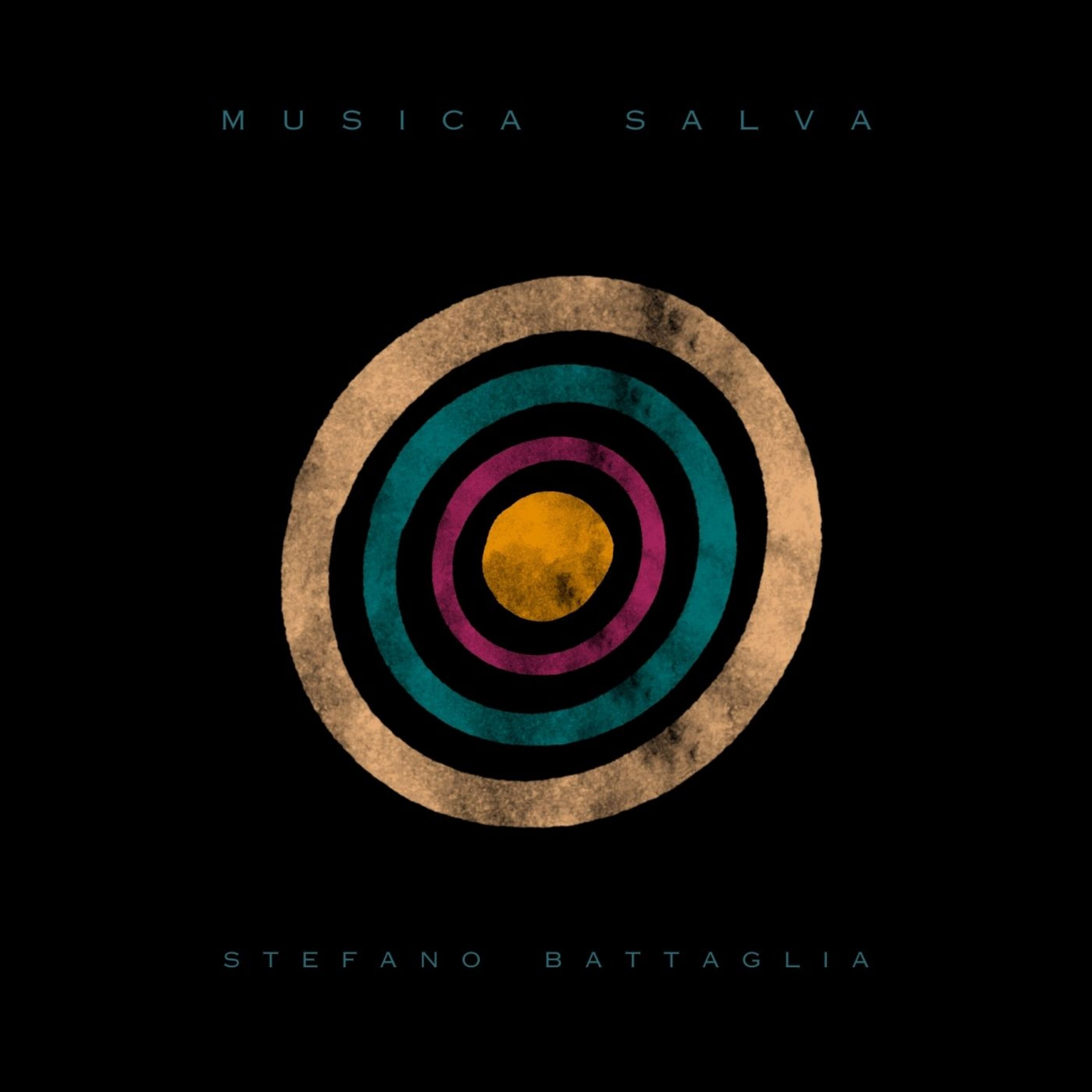
Stefano Battaglia Piano
Music By Stefano Battaglia
Recording July 2011
Live at Fortezza Medicea, Siena (Italy)
Sound Engineer Stefano Amerio
Mixing / Mastering July 2024 Studio Artesuono – Cavalicco (Udine)
Sound Engineer Stefano Amerio
Produced By Laboratorio Permanente di Ricerca Musicale
Siena Jazz – Accademia Nazionale del Jazz
Cover Astra Limen Artwork
Graphics Michela Marzona Per SimulArte
Available on
These are three different forms of salvation.
The first is the uncontaminated purity of free, total improvisation. It represents the spontaneous manifestation of a nature free from expectations or foresight.
The second salvific element is that of offering, of dedicated memory. To play “outside oneself” means to dedicate the musical gesture, by principle, to an event, a place, a person—something other than oneself. This gesture “saves” the performer from a narcissistic, self-celebratory dimension and, at the same time, saves from oblivion the memory from which the music draws inspiration and toward which it is projected in a virtuous cycle.
Since the late 1990s, Musica Salva has been the title of many of my improvisation concerts, each naturally shaped by different inspirations, often tied to contemporary events.
Finally, the music in this concert truly was “saved.” We recorded every day of the masterclass, yet the material I had performed was gone. Lost. Inexplicably untraceable. Then, years later, it was miraculously found—but significantly damaged. Ultimately, it was fully recovered and rescued by Stefano Amerio, who had recorded the entire piano symposium from which my improvisations were drawn. Only Stefano’s devoted work made possible what I consider a small miracle, restoring the recordings to good condition.
For all these reasons, Musica Salva is an inevitable title.
TRACK LIST
Volume 1
In the first album, the one dedicated to the symposium, the pieces appear in the following order. Exilium is inspired by anthropological movements—the eternal drama of uprootedness and exile, the countless tragedies caused by diasporas, cataclysms, war, and poverty. In that year, the sea route toward the Strait of Sicily was marked by two major disasters: in March, a boat sank off the Tunisian coast, causing at least sixty victims; two other boats that had departed from Libya—one with 335 migrants and another with 68—were declared missing, and all trace of these hundreds of souls was lost in the Mediterranean.
The improvisation Exilium, based simply on an open fifth and free melodic variations using the traditional responsorial technique of call and response, gradually underwent a process of crystallization. Because of its tragic relevance, I have performed it many times in concert over the years; it also appears on the 2017 live album Pelagos (ECM 2570/71).
Prelude for Bill Viola is dedicated to the great American artist.
Musica Salva, Ricercare, and La Parte Azzurra della Fiamma are three tabula rasa improvisations. The first two unfold through simple melodic–rhythmic subjects that emerged spontaneously and which I harmonize in the moment to create two very different, contrasting narratives: the first resembling a simple song, the second a kind of invocation.
La Parte Azzurra della Fiamma embodies passion and devotion to music; the blue core is its generative nucleus. If the flame represents the musical entity in all its complexity and articulation, the blue part is improvisation—the center.
The next piece, Del Mio Cuore una Dimora, is dedicated to the Lebanese poet Kahlil Gibran. Its title quotes one of his verses: I shall make of my soul a casket for yours, of my heart a dwelling place for your beauty. I shall sing your name as the valley sings the echo of bells. I shall listen to you speak as the sand listens to the story of the waves.
One of the techniques explored during the symposium was the evocative method, through which free improvisation is shaped exclusively by simple keywords acting on inspiration—and thus on the performer’s emotional and psychological system—both creatively and associatively, as well as semantically. Knowing my passion for Schubert, one of the colleagues present “suggested” that I offer a homage to the Austrian composer through an evocation referring to his celebrated song cycle Winterreise. Hence the decision to give the improvisation this romantic title: Unterwegs—“journey.”
I Am Here and Augmentation are two additional tabula rasa improvisations, each based on a single parameter (the former on the projection of fourth intervals, the latter on the polyphonic structure of a simple augmented triad).
The ideal condition of the improviser is total presence. I am here now, in this place and with this instrument, creating music. What more could one possibly desire?
Keyman is a spontaneous homage dedicated to Keith Jarrett and Manfred Eicher—a gesture of pure gratitude toward both. The common denominator linking us is one of Eicher’s own creations: the ECM universe, with which I grew up as a devoted listener and with which I now have the privilege of collaborating as a musician. I am deeply grateful to Manfred for having created a space in which the most beautiful music on the planet—of every era and genre—has coexisted harmoniously, without distinction of any kind, defining a trans-idiomatic model and philosophy with which I grew up and which I fully share. Centripeta embodies this communion of philosophies.
My gratitude is eternal for his support of my music through a collaboration spanning seven albums, three of which are double albums.
Gratitude toward Jarrett is more obvious, due to the instrument we share and his initiatory role (his Facing You, released on ECM, was the first solo piano improvisation album I ever heard, toward the late 1970s), certainly a powerful reference point for me and for the entire community of “cross-idiomatic” improvisers. The title Keyman, beyond its literal meaning, is a portmanteau of the two names Keith and Manfred. The image I have in mind is a photograph of the two of them, seriously focused while playing a game of ping-pong: Manfred, elegant and poised, drawing perfect arcs; Keith, concentrated and determined as always, playing in defense.
Monte Analogo is the first composed piece (end), dedicated to René Daumal and to his book of the same name, shaped by Gurdjieff’s teachings and centered on the mysticism of the mountain. The two-voice melody of Il Monte Analogo consists of ascending and descending arpeggios that ideally trace mountain profiles across the staves.
This is followed by a final improvisation governed by a double evocation requested by the pianist friends present: a march rhythm and polytonality—the harmonic tradition that reached its zenith in the first half of the 20th century with the triad of Hindemith, Bartók, and Stravinsky. Paradoxically, the title The Grand Parade is instead an homage to the last album Peter Gabriel recorded with Genesis, The Lamb Lies Down on Broadway, which includes a track titled The Grand Parade of Lifeless Packaging. The two share only the parade-like rhythm.
The album concludes with one last brief encore: this time, a composed piece inspired by a short story by Edgar Allan Poe (The Devil in the Belfry), in which, in an imaginary village obsessed with punctuality, a little devil hidden in the belfry delights in unsettling the community by moving the hands of the clock.
VOLUME 2
The concert is documented on the second CD, presented in its original dramaturgy along with an encore. Among the most compelling topics explored throughout the entire piano seminar, the one centered on morphology-based form was the most extensively developed: it concerns the very concrete possibility of building a dramaturgy through precise yet empty structures—forms without preexisting subjects—thus seeking a balance between the blank page of tabula rasa and composition, shaping clear and simple forms that could come alive anew in every performance through subjects created in the moment. These structures are like rooms that, each time, are inhabited by entirely improvised elements.
For many concerts, one such form was inspired by The Ascent of Mount Carmel (Subida del Monte Carmelo) by Juan de la Cruz—a poetic work and method of spiritual elevation based on his poem En una noche oscura, describing a mystical journey metaphorically (and graphically) represented by a mountain. Mount Carmel, in Palestine, is part of a mountain chain in Upper Galilee that descends toward the Mediterranean. On this mountain, in the 12th century, the lay community of Carmelite Fathers was born: a group of lay hermits dedicated to contemplation and meditation, later forced into migration and ultimately reformed at the end of the 16th century by Juan de la Cruz and Teresa of Ávila.
Imprisoned in Toledo, from which he escaped by descending a rope made from torn pieces of blanket—the most classic of escapes—Juan conceived the description of this spiritual ordeal, a true initiatory crossing, akin to a fierce desire to draw near to the Divine through a cathartic rebellion: an experience that, in fact, contributed both to the birth of the poet and mystic, and to his own symbolic rebirth represented by escape itself: “A thousand years in that little prison would not be worth one of the graces the Lord granted me there.”
Juan’s writing is symbolically set in the darkness of night, as though it were a long journey in profound blindness and silence.
This itinerary is structured into four Gradus:
I – Nigredo, Oblivion, Silence
II – The Ascent of Mount Carmel (Subida del Monte Carmelo)
III – Voluntas, Canticle
IV – Intellectus, Lamma Sabachtani
Accordingly, this is the morphology I used for the long opening improvisation Obscura.
The poet Rainer Maria Rilke, at the beginning of the 20th century, wrote: “The abyss between us and God is filled with the darkness of God, and when one feels it, one must descend and howl into that abyss. This is more necessary than crossing it.”
These words perfectly explain the essence of music inspired by the work of Juan de la Cruz, for these processes concern experiential knowledge of the Divine—a knowledge that is neither illumination nor cognition.
What is experienced in it is not acquisition but dispossession.
Not radiance, but obscuration.
Not advancement into clarity and abundance, but a sinking into the darkness of the noche oscura.
The mysticism of Juan de la Cruz is total negation and surrender; the experience is that of a presence indistinguishable from absence.
The mantra of Mount Carmel reads:
To reach the enjoyment of all things,
desire to enjoy nothing.
To reach the knowledge of all things,
desire to know nothing.
To reach the possession of all things,
desire to possess nothing.
To reach the being of all things,
desire to be nothing.
Nakedness and privation—a discipline of the soul articulated through the three virtues of the human being (intellect, memory, and will), which Saint Augustine considered a reflection of the Divine Trinity. If music itself is a divine entity and representation, mirroring the human figure, we may easily identify in sound the voice of music (initiation); in rhythm the body of music (sexual center); in melody the heart of music (emotional, spiritual center); and in harmony the cerebral center (psychological, intellectual). Anyone who works with music can easily recognize, like a prism, this kind of revelation—unfolding through similar pathways, disciplined by rules (and mountains) that are equivalent in many respects.
The morphology of the improvisation Obscura, conceived as a suite, begins with a timbral and abstract introduction (Gradus I: blackness, oblivion, silence), followed by a rhythmic mantra (Gradus II: Subida del Monte Carmelo) and then a melodic one (Gradus III: the Voluntas Canticle), culminating in the anguish and despair of abandonment (Gradus IV: Lamma Sabachtani—“why have you forsaken me?”). In Christ, these words also affirm his humanity and identification with human suffering—the climax of the Passion, a manifesto of love and vulnerability.
For the artistic community especially, Juan de la Cruz’s insistence on the second virtue—memory—deserves reflection. In some sense it corresponds to the concept of residual essences, which in music we might compare to languages and styles that improvisation urges us to transcend in favor of a truth more unique, pure, and essential.
Whereas academic ars memoriae tends toward cataloging, appropriation, and mastery of all contents through schemes, the technique of Saint John aimed at the opposite: expropriation, emptying. This explains his theologically “imperfect” poetic writing—deliberately ingenuous and Franciscan—with echoes of songs and popular verse, coplas and glosas of Castile, and likely influences from Iranian Sufism and Ramon Llull, who wrote at the time: “The Saracens have religious men called Sufis who use words of love and passion to instill faith and devotion.”
The improvisations following the Obscura suite are all inspired by the work of de la Cruz and by this conscious dialogue between searching and relinquishing—so central to musical action in general, and especially in the process of free improvisation.
A voce returns to a practice that has always fascinated me: disciplining the pianist’s mind and body into a condition of limitation and dispossession, renouncing any form of polyphony or multifunction between the hands, in favor of a vocality that concentrates on details of song—timbre, ornamentation, single notes. Even when describing harmonic movement in the manner of Bach’s partitas for monodic instruments (such as the A-minor Partita for flute).
Animato is one of the most beautiful evocations used in musical agogics—playing on the idea of “movement,” yet also implying “full of life, endowed with soul,” conditioning the performer physically and emotionally.
Castigliana is a challenge: improvising a folk song influenced by a specific (physical and cultural) geography—here, the land that gave birth to Juan de la Cruz in Fontiveros in 1542, in the historical heart of Spain: the land of castles and the crown, of the gypsy nomadic flow; a territory encompassing Madrid, La Mancha, Seville and Salamanca, Córdoba and Toledo, Segovia and Ávila, with their engaging musical traditions, full of emotion and passionate melodies. My mind goes immediately to the Cantigas de Santa Maria—powerfully narrative and rich with influences from across the Mediterranean.
Then comes Vondervotteimittis, which I had already performed earlier in the day and which I kept in a double version, placing it as an interlude between Castigliana and Glosas in order to briefly counterbalance—at least on the record—the fervent climate infused with Iberian influences. I have already spoken of Vondervotteimittis, being the only composed piece alongside Monte Analogo.
Almost consequentially from Castigliana comes the improvisation Glosas, evoking the recitative form of a text—a poetic nucleus whose stanzas return and comment, adding perspectives and interpretations. In the Hispanic tradition, it is a genre that requires improvisational ability and mastery of specific metric schemes.
The concert closes with Llama de amor viva, a direct homage to Juan de la Cruz’s lyric Canciones del alma: Oh llama de amor viva (“O living flame of love”), carrying the sensation of singing love itself—inhabited and surrounded by this flame.
Finally, Cantico Espiritual is the encore: an improvised chant pursuing the idea of the Canciones del alma, representing a moment of inner peace and almost Franciscan union (el alma y el esposo) achieved through surrender. I follow a simple melody with determination, and the harmony always resolves while nonetheless moving through continual modulations.
“Of all the things you hear, see, taste, and touch, keep no record, nor let memory seize upon them. Let them fall immediately into oblivion. Pursue this, if necessary, with the same diligence others apply to remembering, so that no trace or shadow of them remains in memory—as if they were not in the world at all—leaving memory free and unburdened, bound to no consideration either high or low, letting it freely dissolve into oblivion, in direct contact with the soul. The operations of memory, in this state, are entirely divine, for in touching the absolute part of man, they themselves become divine, bearing no will other than that of the divine.”
In this thought of Juan de la Cruz lies a powerful—and effective—teaching, due to its subtle analogy with the psychology of the performer in improvisation (memory and possession, expectation and error, ego and judgment). It also resonates strongly with the involuntary memory through which Proust evoked impressions liberated from time and passionate apprehension—in the fleeting moment of their ecstatic birth—that inaccessible essence of reality which we seek and seek again through improvisation and composition, so necessary whenever we create music.
Glossary
Manifestation and Representation
All music that is, by principle, freely and fully improvised in its entirety—and therefore unrepeatable and in no way replicable—is saved from the risks of representation, preserving instead its essential quality of manifestation, the truth of the now. All phases that normally lead toward writing, decoding, and infinite reinterpretations are annulled in favor of its spontaneous nature.
It survives in time exclusively thanks to the recorded document that keeps it alive and rescues it from oblivion; without such a document, it would be destined to vanish at birth, like anything incapable of leaving a trace—whether written or transmitted orally.
Awareness of Space and Sound
Improvisation lives from and within its context—here and now. We must never underestimate this spatial awareness of sound.
Those who produce the sounds inhabit the same time and the same space as those who listen; the physical conditions of the place and the instruments equally contribute to shaping the musical flow. There is no going back, no changing or correcting anything: sonic gestures are born from one another, either as personal affirmations or as reactions to something outside oneself.
Everything arises suddenly, without a final goal to reach. It is a being in the doing, a knowing discovered through a process of continuous search and experimentation—sharing the same root as the word “experience”.
Instant Composition
The practice of musical improvisation, beyond cultivating skill, can be a simple liberating act, an expressive urgency, a natural and spontaneous relationship between the musician and the music.
The art of improvisation, however, transforms this practice through higher ambitions, embracing a grammar and syntax very similar to those of composition: an act of conscious instinct, and even a potential alternative form of writing built upon a radically integral creative principle—constructing its structures from a completely empty space, a blank page.
That blank page is silence.
All subjects to which we attribute thematic value are created in the moment, yet they share both the narrative principles and the formal objectives of those found in traditional composition.
Over the years, this experience has come to be called instant composition.
The Distance Of Time
The only true difference between the composer and the instrumentalist devoted to tabula rasa instant composition lies in the time granted to the creative process.
Even under pressure from a commission, the composer allows themselves indefinite time to choose, refine, and resolve every step. The improviser, on the other hand, must build with what is there—without using time or energy to judge, modify, or discard, because once something is played, whatever it may be, it is already music, already written into form, even if unintended.
If composition is a search, improvisation is a discovery and a revelation—or, if the term is allowed, a rediscovery.
Its defining trait is irrepeatability: improvised music is born, dies, and disappears at the same time; it lives only for the duration of its epiphany. To bridge this unbridgeable temporal gap between composition and improvisation, the work of the sound engineer—the thaumaturge—is indispensable.
The Writing Of Sound
Today, I feel compelled to say that composition and improvisation are exactly the same thing, bound by an irreducible reciprocity.
Composition is an experience of opposing Time.
Improvisation, by contrast, exposes itself to the vertigo of temporality: like time itself, it is the unfolding of an undetermined content in an irreversible becoming.
The attempt to combine these two experiences requires a form of writing: the recorded document.
The Offering
Another gesture that “saves” music—though in an entirely different sense—is the traditional act of offering: the composer or improviser draws inspiration from something beyond themselves and, at the same time, offers the music as a means of connection and communion, projecting it toward something or someone.
In doing so, it saves from oblivion and silence the people, places, and events that inspired it, contributing to the creation or restoration of memory and restoring the communal meaning of music.
It repositions the musician within a responsible, exposed, and participatory space—connected to the truths of the world, in contact with reality or, as Rilke said, with the unreality that is real.
In recent decades, music that saves has been one of my primary activities, both as composer and improviser, through countless pieces in the form of song and dance—acts of memory and celebration inspired by places, peoples, individuals, and events. A body of work that seeks to celebrate life through an artisanal gesture—ritual, everyday, simple, timeless—one that has existed forever.
Thanks
I care deeply about expressing my profound gratitude to the philosopher Giorgio Agamben—not only for his magnificent translations of Juan de la Cruz, but also for his enlightened (and enlightening!) writings, which have fascinated me over the years, including those that accompany and prepare the reader for the works of the Spanish mystic.
Finally, I must thank once again Stefano Amerio—not only for the bond we have built over twenty-five years of collaboration, but for his work in rescuing the acoustic material.
He is the thaumaturge of this album. For me, it is a privilege to (re)find things played decades ago and to (re)cognize the same seed that lives within me today (the flame, Juan de la Cruz would say)—the very same seed that was already sprouting when I was a child: the enchantment of sound, the joy of inhabiting it, the surprise of creation, the boundless love for music and the devoted gratitude for having cradled and accompanied my entire existence, granting me the experience of feeling in harmony with the universe and with all that is divine.
Allow me a final remark, given the recurring presence of “salvation” and the many allusions to mystics of the past:
if it is true—as indeed it is—that the aim of the true mystic is to become themselves a celestial earth in which to resurrect or reincarnate, or to identify with the supreme stone of the elements as in the alchemical opus, then I wish for my body, after so much passionate and inadequate striving, to transform itself into sound—one day!